Kali’s Compassion

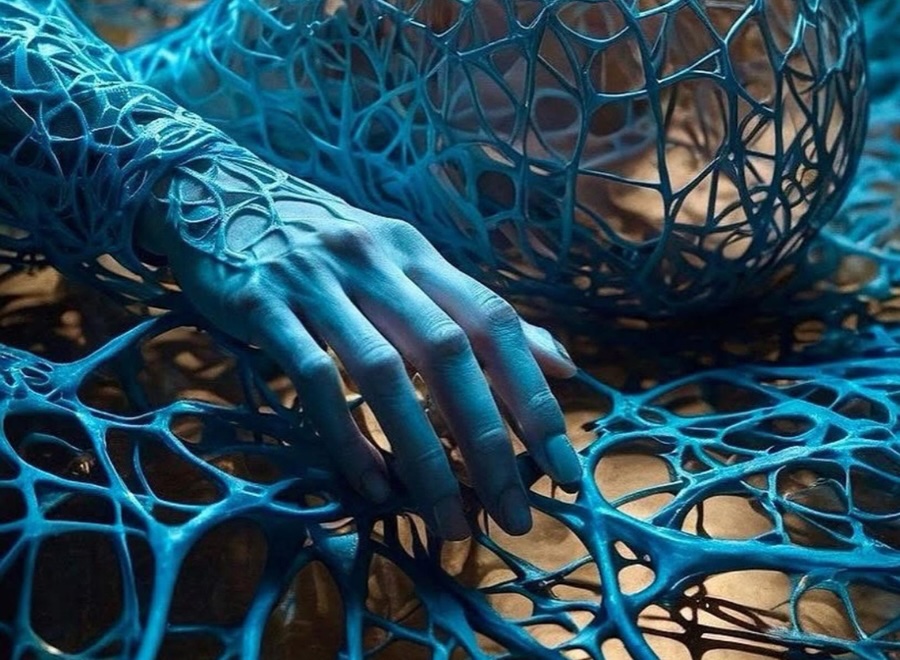
In the vast pantheon of Hindu deities, few figures embody such raw, primordial power as Kali, the dark goddess who stands at the intersection of life and death, creation and dissolution. Her blue-black skin—the color of infinite space—and her wild, unbound hair speak to forces that existed before form, before language, before the world as we know it took shape. Kali’s iconography confronts us with uncomfortable truths about existence itself. Adorned with a garland of severed heads, her tongue extended in fierce determination, she is not the gentle mother figure we might expect from a goddess associated with creation. Instead, she reveals a deeper truth: that creation and destruction are not opposites but partners in an eternal dance. This is perhaps the most challenging aspect of Kali’s teaching for the modern mind to grasp. We have been conditioned to see creation and destruction as binary opposites—good versus evil, life versus death, building versus tearing down. We celebrate creators and condemn destroyers. We frame existence as a battle between constructive and destructive forces, and we know which side we’re supposed to be on.
Kali laughs at such simplistic thinking. She shows us that this duality is itself an illusion, born from our limited perspective and our attachment to permanence in a fundamentally impermanent universe. Consider the forest floor: when a great tree falls, we might mourn its destruction. Yet its decomposing trunk becomes home to insects, fungi, and microorganisms. Its nutrients feed the soil. Saplings that once struggled in its shadow now surge toward the light. The death of one tree is the birth of an entire ecosystem. Destruction and creation are happening simultaneously, inseparably, in the same event. Or consider your own body: right now, even as you read these words, millions of your cells are dying while millions of new ones are being born. You are being destroyed and created, continuously, without pause. The “you” of seven years ago is quite literally not here anymore—nearly every cell has been replaced. Yet you remain. This is the dance Kali teaches. The heads strung around her neck—often numbering fifty, representing the fifty letters of the Sanskrit alphabet and thus all sound, all language, all conceptual thought—are not trophies of cruelty but symbols of ego, attachment, and illusion. Each head represents a false identity we cling to, a story we tell ourselves about who we are: I am my job, I am my relationships, I am my achievements, I am my failures, I am my body, I am my thoughts.
Kali’s garland proclaims: all of these identities must die. Not because she is cruel, but because they are lies, and lies create suffering. The ego’s primary project is to establish permanence in an impermanent world, to create a stable, continuous “self” that will endure. But this is impossible, and the attempt to achieve it causes tremendous pain. In her fierce compassion—and this is crucial, it IS compassion—Kali destroys what must die so that truth can live. She is the spiritual surgeon who doesn’t flinch from the necessary cutting. She is the forest fire that clears the deadwood so new growth can emerge. She is the fever that burns through the illness. Her very name derives from “Kala,” the Sanskrit word for time. Kali is time personified—the force that brings all things into being and inevitably reclaims them. She reminds us that impermanence is not a flaw in the design of existence but its very essence. Everything that begins must end. Every creation contains the seed of its own dissolution. Yet this is not a message of nihilism. In Hindu philosophy, destruction is never final. It is transformation, the necessary clearing away of the old to make space for the new. The cosmic recycling program, if you will, with Kali as its fearsome administrator. Contemporary society is experiencing an identity crisis of epic proportions. Traditional markers of identity—career, religion, nationality, gender roles, family structure—are all in flux. The stories we inherited about who we’re supposed to be and how life is supposed to unfold no longer hold. This is terrifying for many people, and understandably so. But it’s exactly the kind of ego-death that Kali specializes in. Those fifty heads on her garland? In the modern context, they’re the identities we cling to: I am my job title, I am my social media presence, I am my political affiliation, I am my relationship status, I am my productivity, I am my net worth. Kali says: Let them go. Not because you’ll become nothing, but because you’ll discover what you are beneath all these constructed identities. The terror of this dissolution is real, but so is the freedom on the other side.
What do you think of this image?