

Lovers
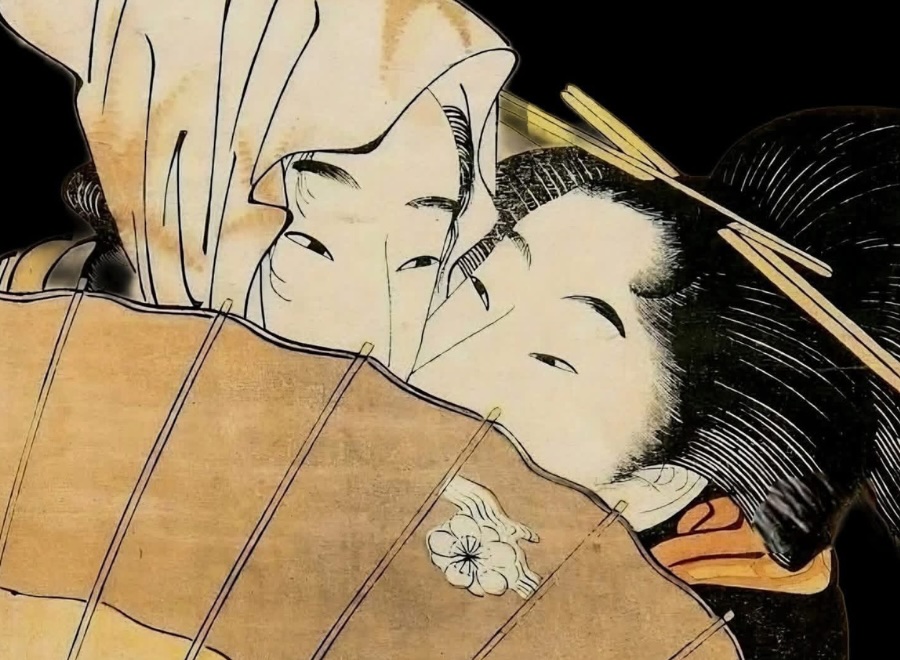
Kitagawa Utamaro “Lovers Behind Umbrella” (ca. 1798-1802) presents Umegawa and Chubei, legendary figures from Kabuki theater, in a moment suspended between the public world and private desire. Umegawa and Chubei were real people whose tragic love affair in 1708 became immortalized in Chikamatsu Monzaemon’s puppet play and later Kabuki adaptations. Umegawa, a courtesan, and Chubei, a courier, fled together with stolen money in a desperate attempt to be free. Their story ended in double suicide, transforming them into symbols of doomed romantic devotion. By choosing this couple for his shunga album’s frontispiece, Utamaro invites viewers to see erotic love not merely as physical pleasure but as something inextricably tied to emotion, sacrifice, and the poignant awareness of impermanence—a deeply Buddhist sensibility underlying much of Japanese aesthetics. The concept of mono no aware—”the pathos of things” or “sensitivity to ephemera”—pulses through every brushstroke of this image. This aesthetic principle, deeply rooted in Buddhist teachings about impermanence, holds that beauty and transience are inseparable. Cherry blossoms move us precisely because they fall within days. Love pierces the heart most deeply when we recognize it cannot last forever.
Utamaro doesn’t hide this truth from us. The composition itself—two figures sheltered beneath an umbrella against encroaching darkness—acknowledges the temporal boundaries of their intimacy. The black void surrounding them isn’t simply artistic negative space; it represents the forces of time, fate, and social prohibition that will inevitably dissolve this moment. Yet this awareness doesn’t diminish the scene’s beauty or emotional power. Instead, it intensifies both. The small white flower adorning the garment becomes almost unbearably poignant when viewed through this lens. Like the lovers themselves, it blooms briefly before fading. But Buddhism teaches that impermanence doesn’t negate value—it concentrates it. The flower’s beauty exists because of its fragility, not despite it. Similarly, the lovers’ connection gains significance from its threatened, temporary nature. This is why the couple’s expressions carry such quiet serenity rather than desperate passion. They seem to have achieved a profound acceptance—not resignation, but genuine presence. They’re not grasping at each other, not trying to freeze time or deny reality. Instead, they inhabit this moment fully, perhaps because they understand how rare and precious it is. This emotional maturity reflects a Buddhist practice of mindfulness: being completely present with what is, rather than clinging to what was or anxious about what will be.
In choosing to immortalize Umegawa and Chubei at this particular moment—sheltered, tender, suspended in time—Utamaro offers not just an image of erotic love, but a meditation on connection itself and what it means to be human. Utamaro shows us that erotic love, when embraced with full awareness of its impermanence and combined with genuine sacrifice and emotional depth, becomes one of the most profound experiences available to human beings—a fleeting taste of something eternal: that we are capable of profound connection, that we can transcend our individual isolation, that love can inspire us to acts of extraordinary courage. A person who has once experienced genuine intimacy—has truly been seen and accepted by another—carries that knowledge forever. Even if the relationship ends, even if the beloved dies, the person who experienced that connection has been fundamentally changed. They now know, in a way that cannot be unknown, that such connection is possible. This knowing becomes part of their permanent understanding of what existence can contain. In this sense, the temporary moment creates an eternal shift in consciousness. There’s also profound relevance in how the artwork frames erotic love as inseparable from emotional depth and sacrifice. Contemporary culture often bifurcates sexuality and emotion, treating physical intimacy as something that can be easily detached from genuine connection. Dating apps reduce potential partners to swipeable images; hookup culture promises pleasure without vulnerability or risk. Yet research consistently shows that humans crave what Utamaro depicts: intimacy that integrates physical and emotional, that involves genuine seeing and being seen. The umbrella becomes a symbol not just for these 18th-century lovers, but for what all of us need: a space where we can be fully ourselves with another, where we can set down our performance and defenses, where time can slow and deepen. In our acceleration-obsessed culture, this image whispers a countercultural truth: that sometimes the most radical act is simply to stop, to shelter with someone we love, and to be completely present for whatever time we’re given.
What do you think of this artwork?
Artwork: Kitagawa Utamaro


